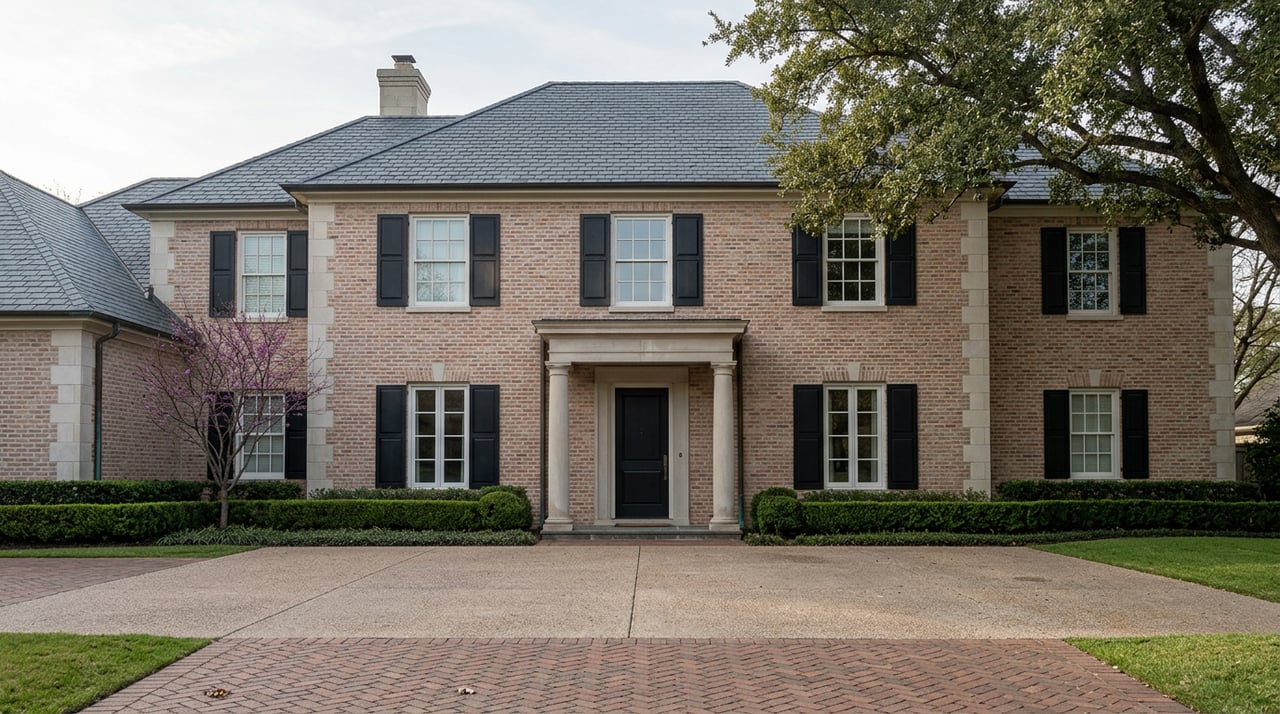
Ask anyone shopping Fort Worth's guarded gates and country club streets to name the city's three best addresses, and you will hear the same trio every time: Westover Hills, Rivercrest, Mira Vista. Lump them together as "Fort Worth luxury" long enough and you start treating them as interchangeable tiers of the same product, three flavors of the same rich neighborhood.
They are not. And the number most often used to prove how hot Mira Vista has gotten actually tells the opposite story once you look at what's underneath it.
The Contradiction Sitting In Plain Sight
Over a recent six-month stretch, Mira Vista's median price per square foot climbed roughly 40 percent, and its median sale price moved from about $1.386 million to just over $2 million. On the surface, that reads like a neighborhood on fire. But in that same window, homes in Mira Vista were closing at only about 91 percent of asking price, averaging around 40 days on market. A market where sellers are taking a nine percent haircut off list is not, by any normal definition, an overheating market.
Both numbers are accurate. They just aren't measuring the same thing.
A median price jump of that size in a gated community with a limited number of annual closings almost never means every home got 40 percent more valuable in six months. It far more often means the mix of homes that happened to sell shifted, toward larger lots, newer builds, or more heavily renovated estates, pulling the median upward even though no individual seller saw anything close to that appreciation. Meanwhile, the 91 percent sale-to-list ratio is the number that actually reflects negotiating leverage on the ground, and it says buyers still have room to push.
For a buyer comparing Fort Worth's guarded enclaves, this matters immediately. If you walk into Mira Vista assuming the headline price jump is a market temperature reading, you will either overpay to "keep up" with a number that doesn't apply to the specific home you're looking at, or you'll assume there's no room to negotiate when the data says otherwise.
Three Products, Not Three Tiers
Once you stop reading these neighborhoods as points on the same price ladder, their actual differences become the more useful story.
| Westover Hills | Rivercrest | Mira Vista | |
|---|---|---|---|
| What it is | Independent municipality, its own police and town hall | Historic neighborhood built around a working country club | Guarded, gated golf-course community |
| Founded | 1930s, developed by architect A.C. Luther on land once owned by Amon G. Carter | Homes built around River Crest Country Club, which opened in 1911 | Modern build-out, largely complete |
| Scale | Roughly 277 homes and about 700 residents | About 194 households | Larger footprint, mostly custom infill remaining |
| Housing stock | Estate lots, some exceeding 3 to 5 acres | Homes averaging 60 to 80 years old, some with rare Texas basements | Golf-course frontage, custom and semi-custom builds |
| What you're buying | Privacy, acreage, a legacy address | Old-money prestige and architectural pedigree | Amenities, security, and a resort-style routine |
Westover Hills isn't a Fort Worth neighborhood in the way people mean when they say "neighborhood." It's a separate town, with its own government, sitting on about 455 acres in the middle of the city. That distinction is not trivia. It means zoning, permitting, and tax rate decisions there run through a town council of a few hundred residents, not the City of Fort Worth. Buyers who want acreage, privacy, and the ability to pass a property down for a generation gravitate here.
Rivercrest sells something different: history you can point to. The neighborhood grew up around River Crest Country Club, which opened in the spring of 1911 with a golf tournament and a barbecue for 500 guests, and many of its grandest homes still sit above the Trinity River along Crestline Road. Basements, rare anywhere in Texas, show up more often here than almost any other Fort Worth neighborhood, a quiet signal of just how old this housing stock actually is.
Mira Vista is the newest of the three stories and the only one built explicitly around amenities rather than acreage or age. It's guarded, it's organized around an 18-hole private course, and its remaining new construction happens as one-off custom infill or teardown-and-rebuild projects rather than fresh subdivisions, since the community is largely built out.
None of these are "better." They are answers to different questions. A buyer chasing legacy acreage and long-term privacy is not actually cross-shopping the same thing as a buyer who wants a guarded gate and a golf cart ride to dinner.
Why Two Of These Three "Markets" Barely Have A Market
Here is the part that should change how you read any headline percentage attached to Westover Hills or Rivercrest specifically.
Rivercrest has about 194 households. Westover Hills has around 277 homes. When a neighborhood that size produces a handful of closings in a given quarter, or even a year, the "median price" isn't a trend line the way it is in a larger submarket with hundreds of annual transactions. It's closer to a snapshot of whichever three or four specific estates happened to change hands.
That means a reported year-over-year increase or decrease in either neighborhood can be driven almost entirely by which particular house sold, not by any shift in what buyers are willing to pay for a comparable property. A 1930s Tudor on two acres selling next to a smaller 1950s cottage on a quarter acre will move a median far more than any actual change in buyer demand. Treat these numbers as a general sense of the neighborhood's price range rather than a precise appreciation figure, and you'll make a better offer than the buyer who anchors hard to a percentage built from a sample size that small.
The Financing Reality That Applies To All Three
Whichever of these three you're weighing, one number applies equally across all of them: according to Rocket Mortgage, the 2026 conforming loan limit for a single-family home sits at $832,750 in most of the country, and no Tarrant County census tract has received a high-cost designation from the Federal Housing Finance Agency that would raise that ceiling locally. Given that home values in Westover Hills, Rivercrest, and Mira Vista all sit well above that threshold, the practical result is the same regardless of which gate you're headed toward: you are very likely financing this purchase with a jumbo loan.
That reshapes the qualification conversation earlier than most buyers expect. Jumbo underwriting typically wants a credit score in the 700s, a down payment in the 10 to 20 percent range or higher, and cash reserves covering roughly 12 to 24 months of payments, all while holding debt-to-income closer to 43 percent or below. None of that is unusual for the buyers who end up in these neighborhoods, but it does mean the pre-approval conversation needs to start before you fall for a specific address, not after.
How To Actually Use This If You're Shopping This Tier
A few practical habits separate buyers who navigate these three enclaves well from buyers who get burned by a headline number.
- Ask for the transaction count behind any percentage you're quoted. A "40 percent increase" built on four sales tells you something very different than the same percentage built on forty.
- Compare price per square foot only within comparable eras and lot sizes. A 1920s Rivercrest estate and a 2020s Mira Vista custom build are not the same unit of comparison, even at similar total price.
- Get your jumbo pre-approval, including the reserves conversation, settled before you start touring. Sellers in this tier expect it, and it's the first thing that separates a serious offer from a curious one.
- Treat sale-to-list ratio as your real negotiating signal, not the median. A rising median with a soft sale-to-list ratio, like Mira Vista's current pattern, usually means there's still room to talk.
For citywide context, Fort Worth's median sale price sat at about $338,000 over the three months ending in May 2026, down a slight 0.65 percent from the same period a year earlier. That gap between the city median and what these three enclaves command is exactly the point: this is a market within a market, and it doesn't move to the same rhythm as the rest of Fort Worth.
A Few Questions Worth Settling Before You Tour
Does Mira Vista's price jump mean it's appreciating faster than Rivercrest or Westover Hills? Not necessarily. The six-month jump in median price and price per square foot lines up with a shift in which specific homes sold, not a uniform 40 percent gain across the neighborhood. The softer sale-to-list ratio is the more reliable read on current demand.
Will I need a jumbo loan no matter which of the three I choose? Almost certainly. As noted above, the loan-limit and high-cost designation details mean home values in all three neighborhoods sit above the threshold where jumbo financing becomes the default path.
Which of the three has active new construction right now? Mira Vista sees the most, though it arrives as custom infill and teardown-rebuilds under architectural review rather than new subdivisions. Rivercrest occasionally sees new builds replace older homes on the same lots. Westover Hills is essentially fixed at its current home count, so new construction there means a rebuild on an existing site, not new inventory.
Fort Worth's guarded-gate market rewards buyers who read past the headline. If you're weighing a move into Westover Hills, Rivercrest, Mira Vista, or want a second opinion on what a specific listing's numbers actually mean, The Agency - Fort Worth can walk through the real comps behind any address you're considering. Get your home's value first, and let's talk about what these three neighborhoods actually offer.
This article is general information, not legal, tax or financial advice. Consult a qualified professional about your situation.